
Identical twins and triplets share the same DNA, but no two people, even identical twins, share the same fingerprints.
This makes fingerprints a powerful tool in identifying who may or may not be associated with a crime, according to Latent Prints Unit personnel of the New Mexico Department of Public Safety Forensic Laboratory in Santa Fe. It is that tool that helps agencies solve crimes throughout the state.
“Our mission is to provide accurate and reliable latent print processing evaluation and comparison of evidence submitted by criminal justice agencies throughout New Mexico,” said Teresa Vigil-Miranda, senior criminal forensic scientist who takes pride in teaching forensics in high schools and at the Explore Academy and has compared her twin daughters fingerprints since age four until now (age 12).
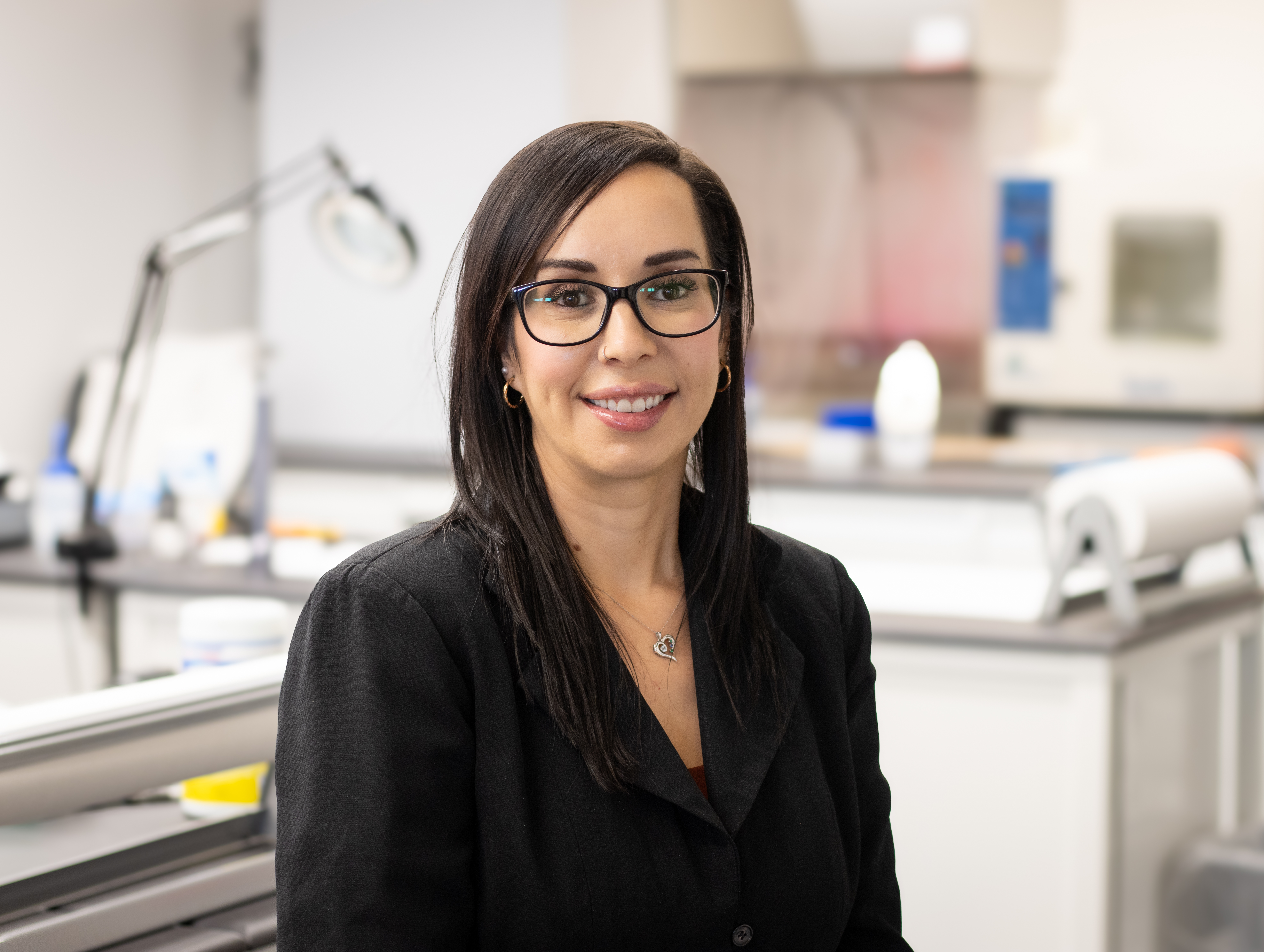 Teresa Vigil-Miranda, senior criminal forensic scientist in the Latent Prints Unit.
The work done by the Latent Prints Unit at the lab is also impartial according to Jeffrey Smith, another senior criminal forensic scientist.
“We don’t make any decisions regarding the overall case,” said Smith who worked crime scenes for the Sacramento Police Department for 14 years and other local and Department of Defense forensic work before coming to the lab in 2014. “We receive items of evidence to process, see if we can develop any ridge detail that is sufficient and make comparisons to see if we can make an association to that item. What that association means is not important to us. That is the investigator’s job to figure out.”
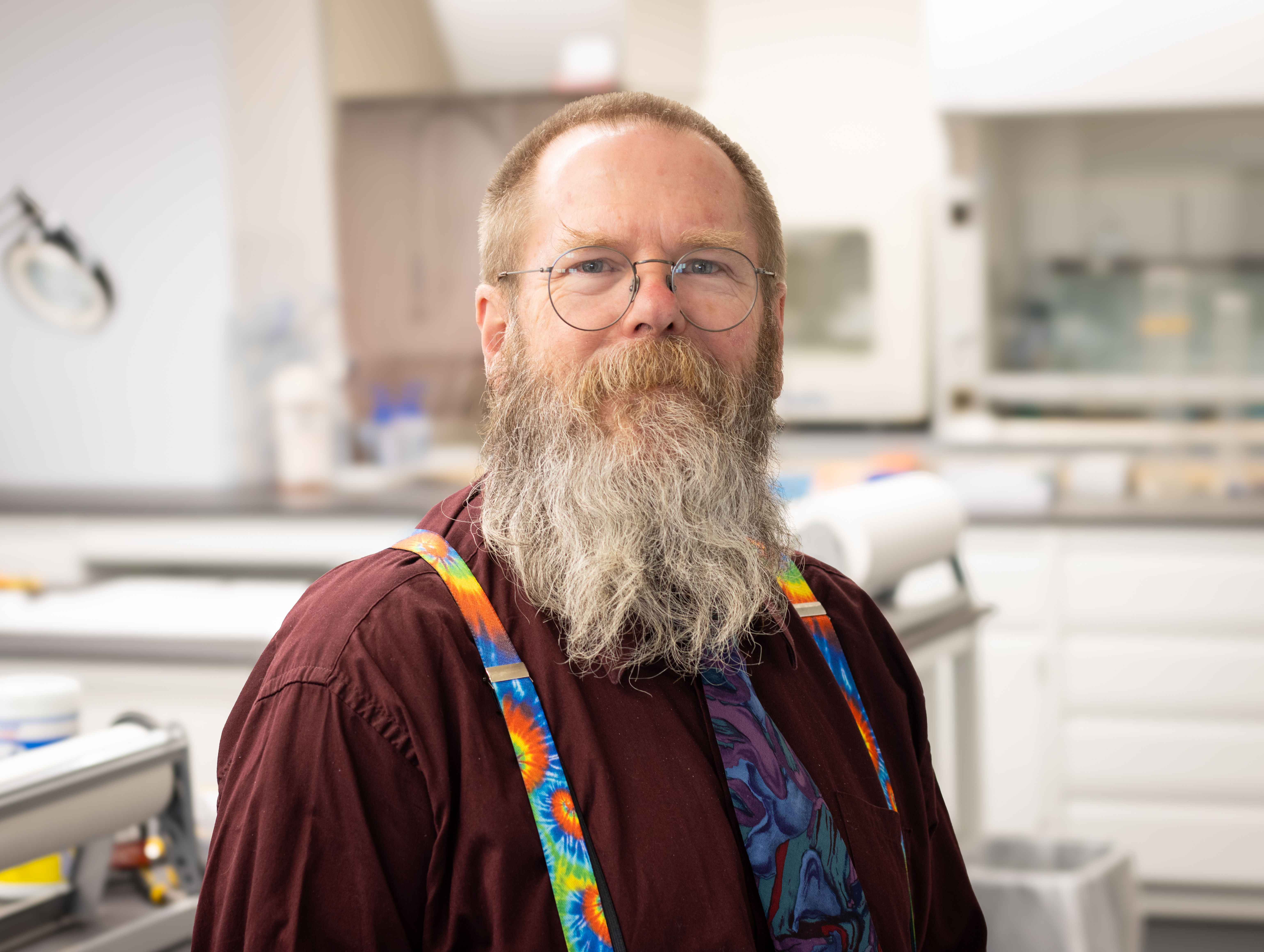 Jeffrey Smith, senior criminal forensic scientist with the Latent Prints Unit.
Reliability and accuracy are crucial to the overall process, and it can take a lot of patience and time, according to Vigil-Miranda who has worked at the Laboratory for 16 years. In some cases, evidence for a particular case can take several months to complete.
Just ask William Gagne, another senior criminal forensic scientist with the Latent Prints Unit who recently completed a case that took a total of nine months, had hundreds of items of evidence, about 100 impressions developed, numerous people to compare, and included multiple hits in the Automated Fingerprint Identification System (AFIS).
“It really depends on case complexity, quality and quantity of items received, type of processing techniques that need to be utilized and the number of comparisons that need to be performed,” said Gagne of the length of time per case.
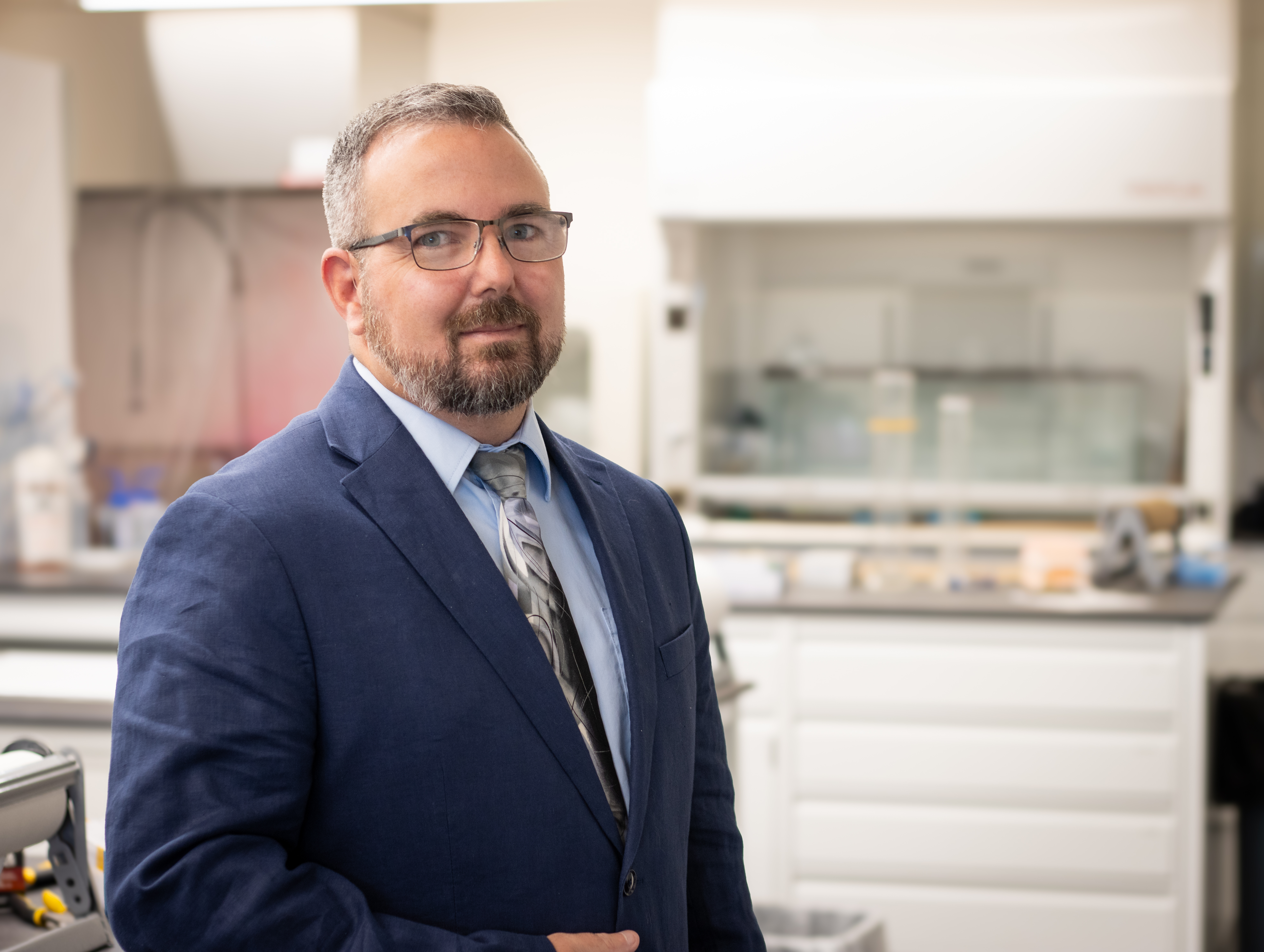 William Gagne, senior criminal forensic scientist with the Latent Prints Unit.
An item as simple as a water bottle can involve many techniques according to Smith and unlike many television shows portray, the process can be tedious not spitting out the image of a suspect on a computer immediately upon entering a print, rather a number of possible comparisons that the scientists have to examine to determine if there is a match.
With nearly four decades in forensic science, Smith explained that when analyzing a non-porous item like a water bottle, investigators start by closely observing the surface. Although fingerprints are often called “latent,” some can become visible under certain lighting and are photographed right away. “The first step is a visual examination, since some prints may be detectable without any enhancement,” he said.
If additional detail is needed, the item is placed in a superglue fuming chamber—similar to the setup (terrarium) shown in Beverly Hills Cop 2—to develop or enhance prints. Technicians then apply a fluorescent dye and use a laser to make the prints stand out, photographing any evidence recovered at each stage. Finally, the prints are compared to known individuals or searched through state and federal AFIS databases if no direct comparison is available.
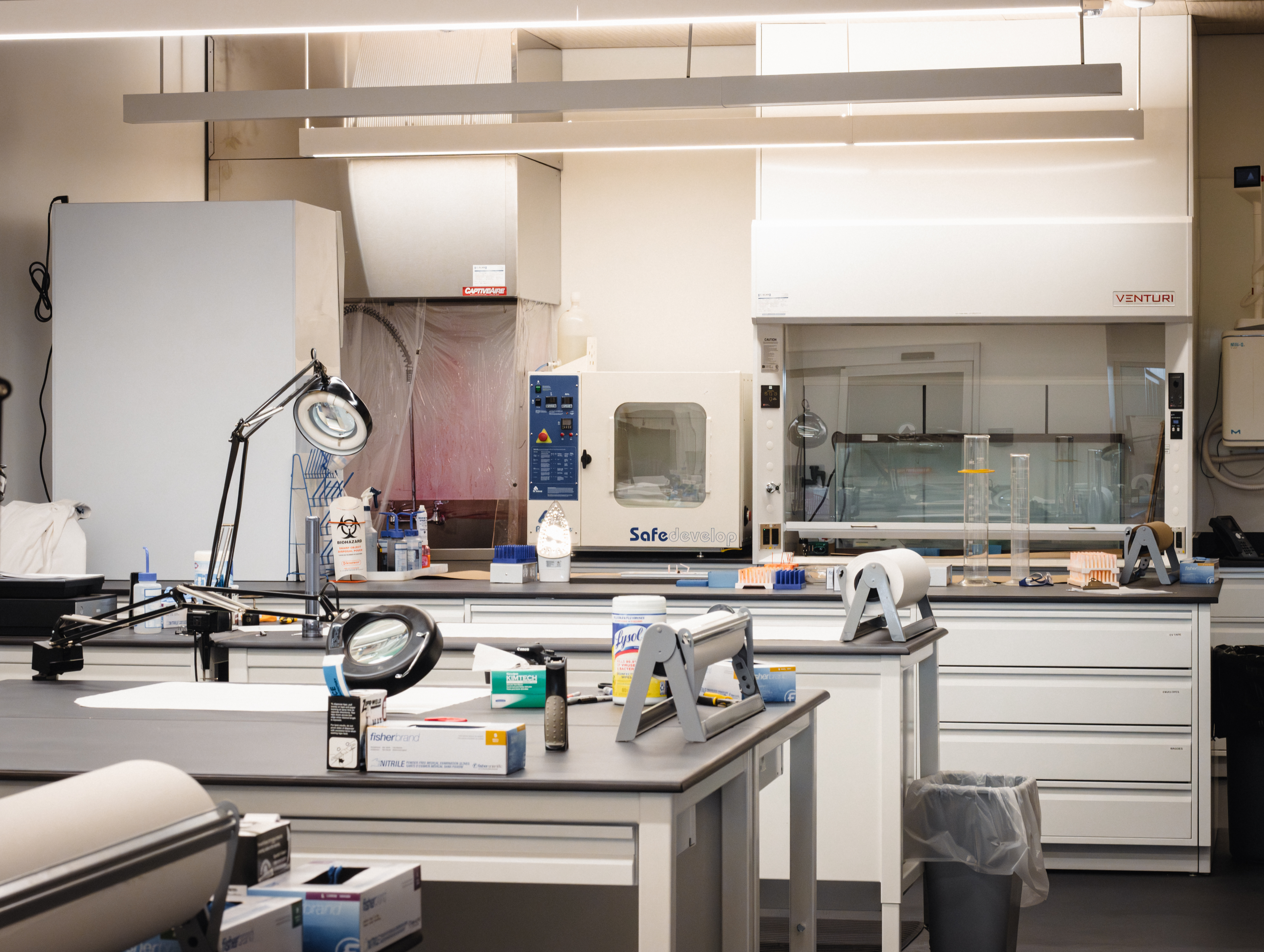 The Latent Prints Unit lab in Santa Fe.
According to Gagne, unknown fingerprints are entered into the AFIS database, which searches and produces up to 15 possible matches. Investigators then review those candidates and compare them to official prints to determine if there is a confirmed match.
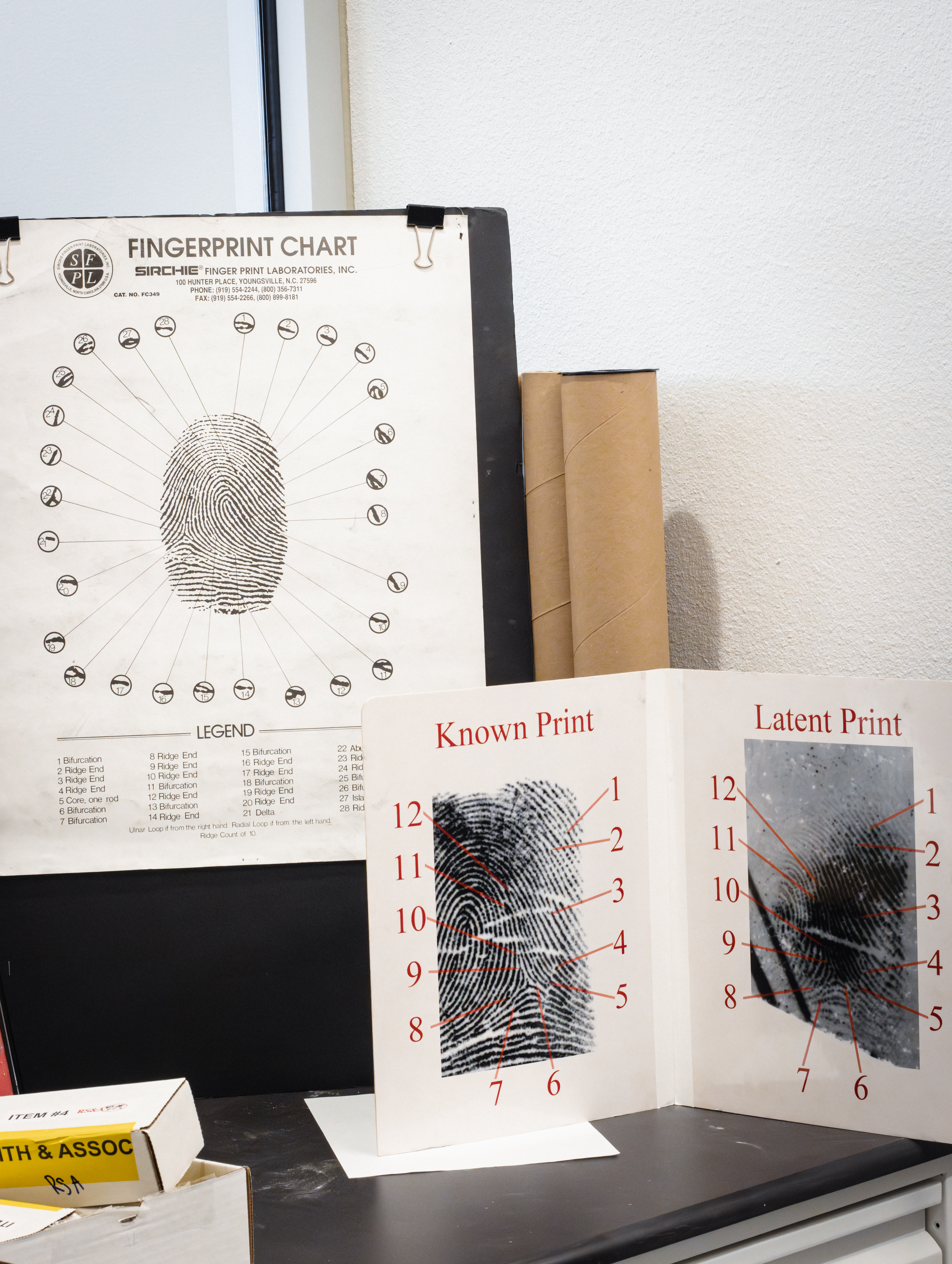 Training display showing correspondence between a latent and known print.
“If it is what we call an AFIS hit, we then obtain the standard of that person and do a comparison and come to an actual conclusion,” said Gagne. “The AFIS database is a tool to assist us – it does not make identifications.”
Vigil-Miranda added that when they do get a match – make an identification – they still don’t know the name of the individual. Rather they receive a state identification number.
The types of evidence received vary considerably and include more than just hard, smooth items like a water bottle, according to Gagne who first started as an intern followed by a position as the attorney liaison (now known as law clerks). And almost anything can be processed for prints except liquids.
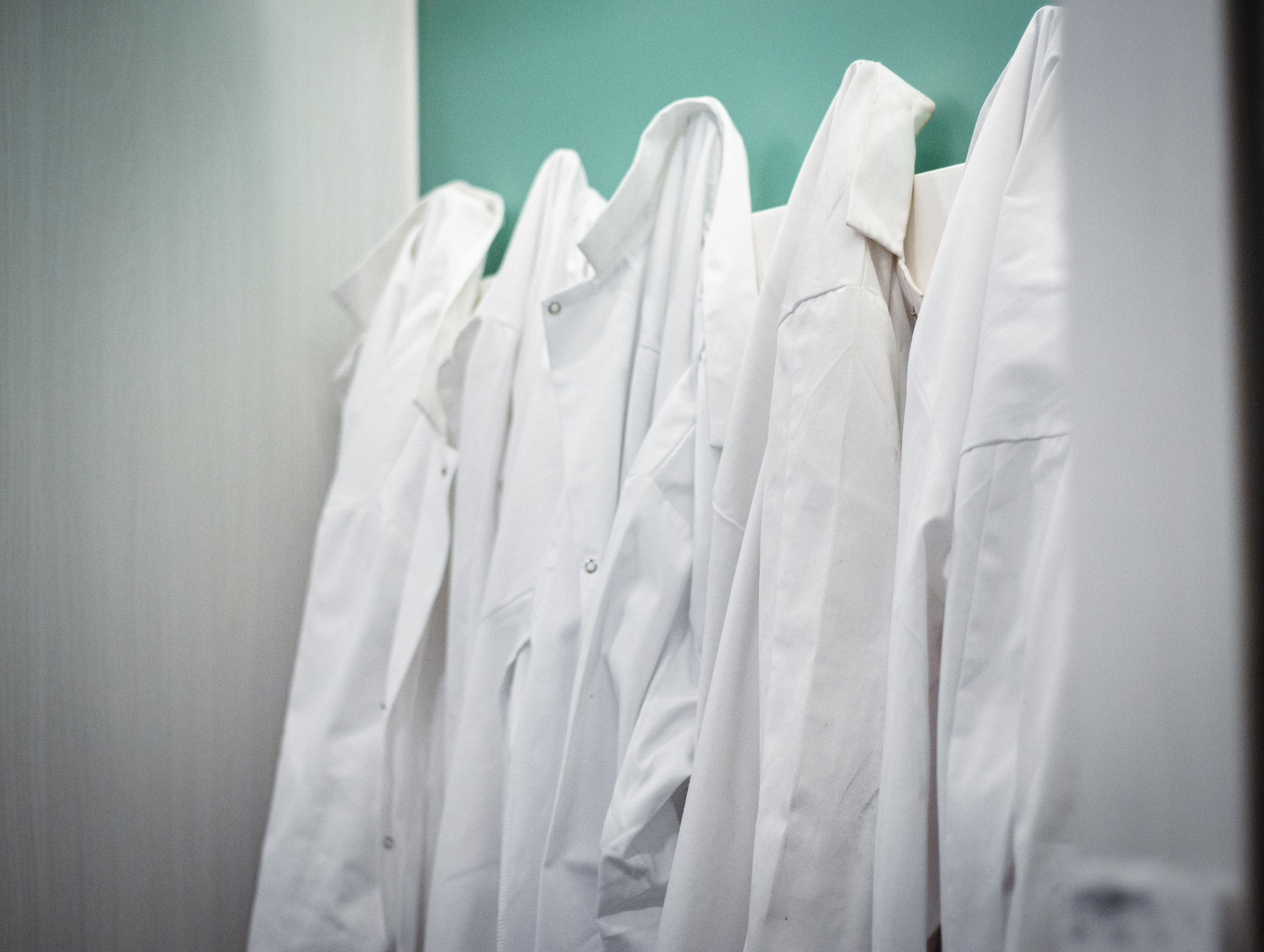 Lab coats in the Latent Prints Unit of the Forensic Laboratory in Santa Fe.
Items the Latent Prints Unit have received over the years include: a full size blue U.S. mailbox, firearms from museums, full size ATM, cans full of dirt, rocks, pottery, ‘smelly’ tarps with liquid on them, a cube-shaped safe, and a pink firearm that curiously, Smith was able to pull prints off of under tape that was wrapped around it.
“The variety of evidence we receive is just astonishing,” said Gagne who also worked previously in the lab as an evidence supervisor before transitioning to latent prints in 2015. “Working in latents is never a dull moment because it is never the same thing.”
 The iron pictured here adds heat and humidity to visualize prints on porous items processed using Ninhydrin.
Besides the wide range of items and techniques that may be used, the process can require significant time and careful attention, according to Vigil-Miranda — especially since skin can shift or stretch.
“Everybody in this field is very detail oriented and meticulous when it comes to evidence processing and comparisons because you have to be,” said Smith.
Gagne agreed: “In instances where you’re dealing with what we call complex latent impressions, where you may have one print on top of another or overlapping and have to break down and discern what information belongs to one of the impressions and what information belongs to the other, you have to be very tedious and methodical, especially working with complex impressions.”
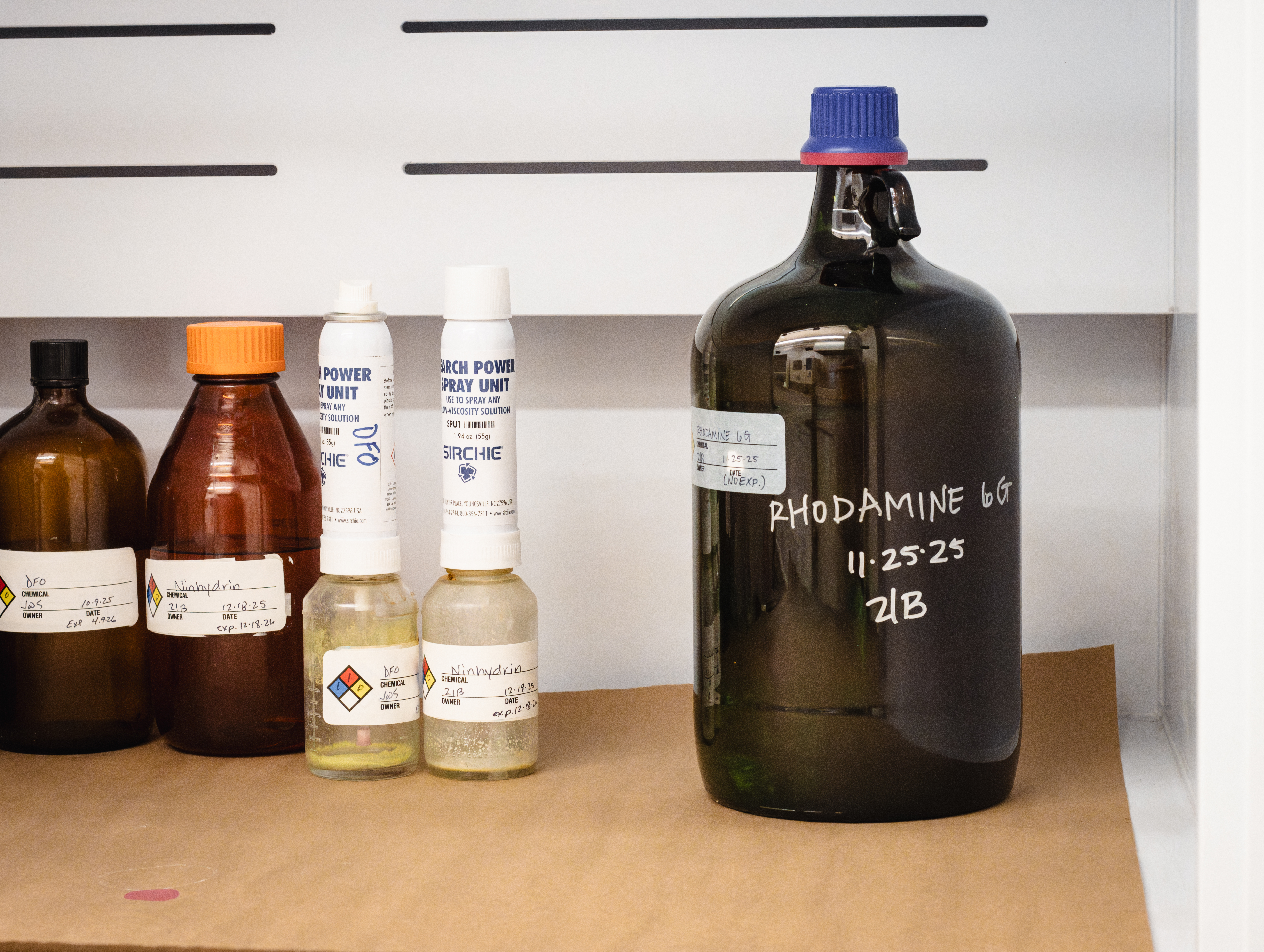 Chemicals used for processing (little bottles – delivery by aerosol (porous processing); big bottle of Rhodamine to replenish the wash bottles).
Training is intense for 18-24 months and while a bachelor’s degree is required for a position with the unit, it does not have to be in science specifically. Instruction is ongoing, with Smith, Vigil-Miranda and Gagne all having used various objects for training/workshop purposes such as a golf ball, banana peel, eggshells, orange and even a feather including instruction from the forensic consultant from the show CSI.
“For the most part people think of crime scenes where you lift prints off of items and for the most part we don’t lift prints off of anything,” said Smith who does have two years’ experience prior to working at the lab, dusting and lifting prints for auto theft cases. “Rather we photograph them on the item and use the photograph for the analysis.”
They do, however, still receive ‘dust and lift’ prints from law enforcement to analyze.
“It’s still relevant because it is impractical to say submit the bedroom window from a house that was burglarized,” said Smith.
In 2025 Smith, Vigil-Miranda and Gagne processed close to 1,000 items each.
“Teresa worked a case where the item was a magazine containing ammunition. It was submitted as one item, but when we examined the item to process it, and we take all that ammunition out of that magazine, it turns from one item into 12 items, so that plays a role in how many items we examine,” said Smith. “Part of that is we don’t want items to be handled before it gets to us – let us do it in a controlled laboratory environment because latent items can be easily destroyed.”
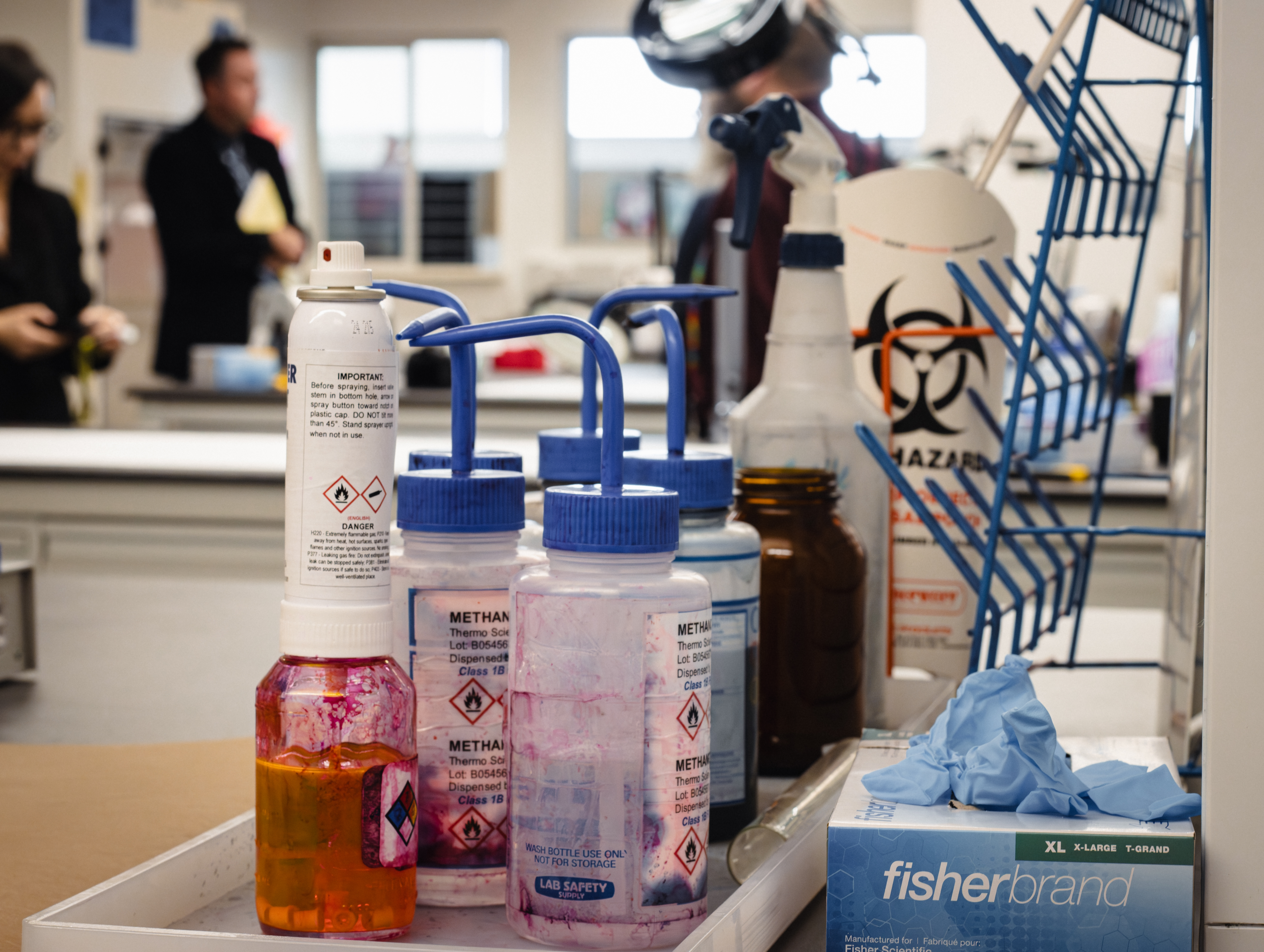 Wash bottles used to apply chemicals to non-porous items.
Once their work is done in the lab, they often are asked to testify in court as expert witnesses. This is where education of what they do is important and they take great pride in this part of the job.
“All of our training is designed to deal with what we call the ‘CSI effect,’ – the Hollywood dramatization of what we actually do. We make it a point to explain to the court and juries what we do, and the misconceptions that may exist because of what was seen on TV,” said Gagne. “My wife will not watch any crime shows with me because as soon as I see an inaccuracy I call it out.”
And they’ve actually been asked about the show CSI in court, with Vigil-Miranda once admitting on the stand that she did not watch it.
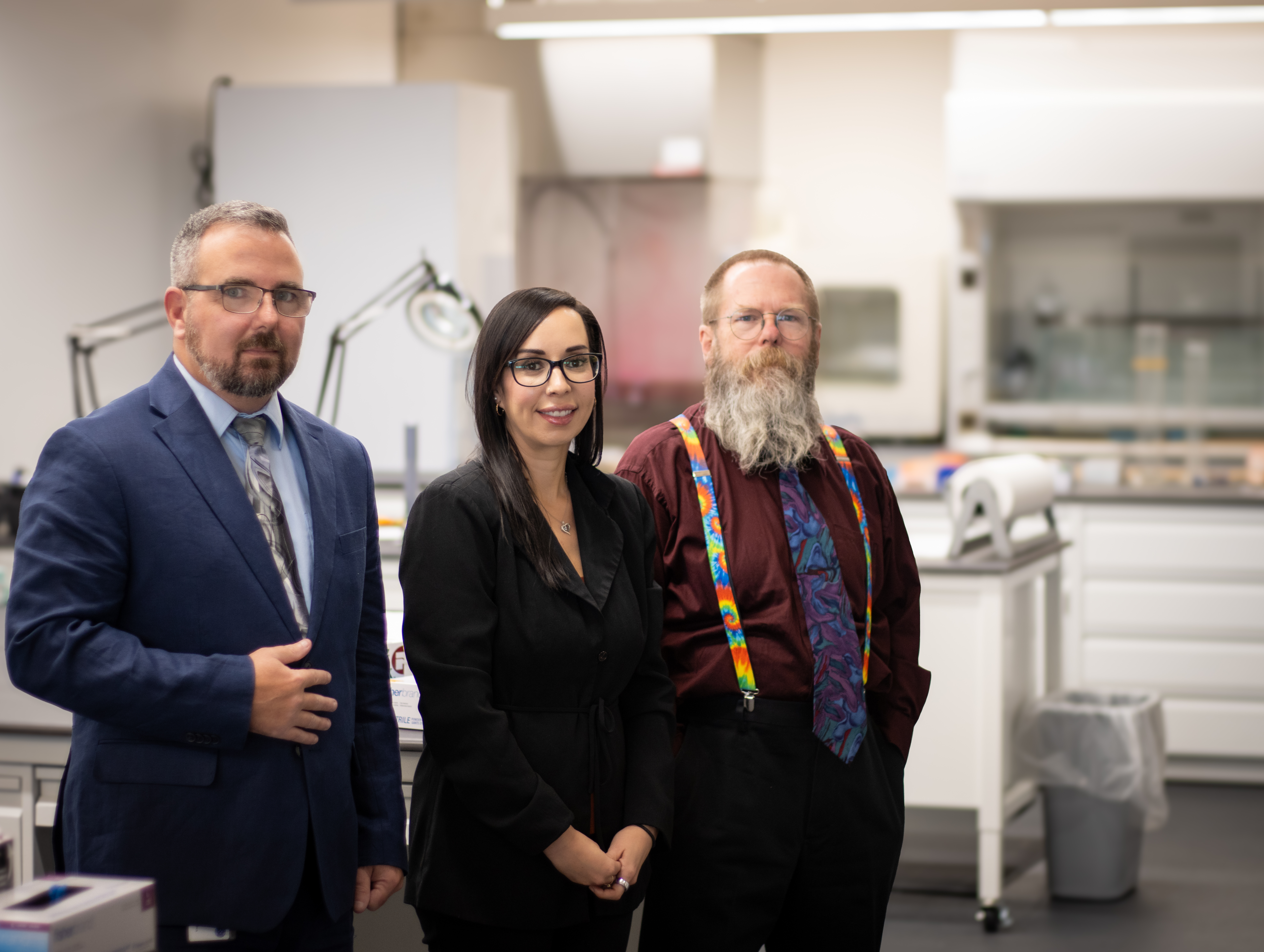 The Latent Prints Unit team from left to right William Gagne, Teresa Vigil-Miranda and Jeffrey Smith.
“I know it works both ways, because when those shows (CSI) first started on TV, it really boosted people’s interest, and people became interested in getting employed in the field, going to school, studying, and then when they actually got to do the real work, some, it was great – others realized it wasn’t what they thought it would be. It takes a specific type of personality to do crime scene work,” said Smith, alluding to it potentially impacting someone’s mental health with what they see and active cases-news stories in the media.
Story by New Mexico Department of Public Safety Public Information Officer John Heil. Photos by DPS Media Relations Unit – Payton Santillanes.