
Imagine getting a second chance in life. A chance to start over if you will.
That’s probably the most fulfilling part of the job at the Expungement Unit of the Law Enforcement Records Bureau of the New Mexico Department of Public Safety according to their management analyst Karen McCutcheon.
“When you get to help the public and fix somebody’s record, that’s very satisfying,” said McCutcheon. “I love deleting those juvenile arrests out of the system, because I just feel like that gives people a second chance – another opportunity, and I’m all about that. So, that’s very fulfilling for me.”
The Expungement Unit led by Technical Support Staff Manager Jessica Mascareñas Rodarte essentially seals records for civil purposes only such as employers background checks, professional licensing and certifications, educational purposes such as financial aid, general civil background checks, or for housing. It doesn’t remove the criminal history from their record for criminal justice purposes such as purchasing a firearm, criminal investigations, or receiving a speeding ticket.
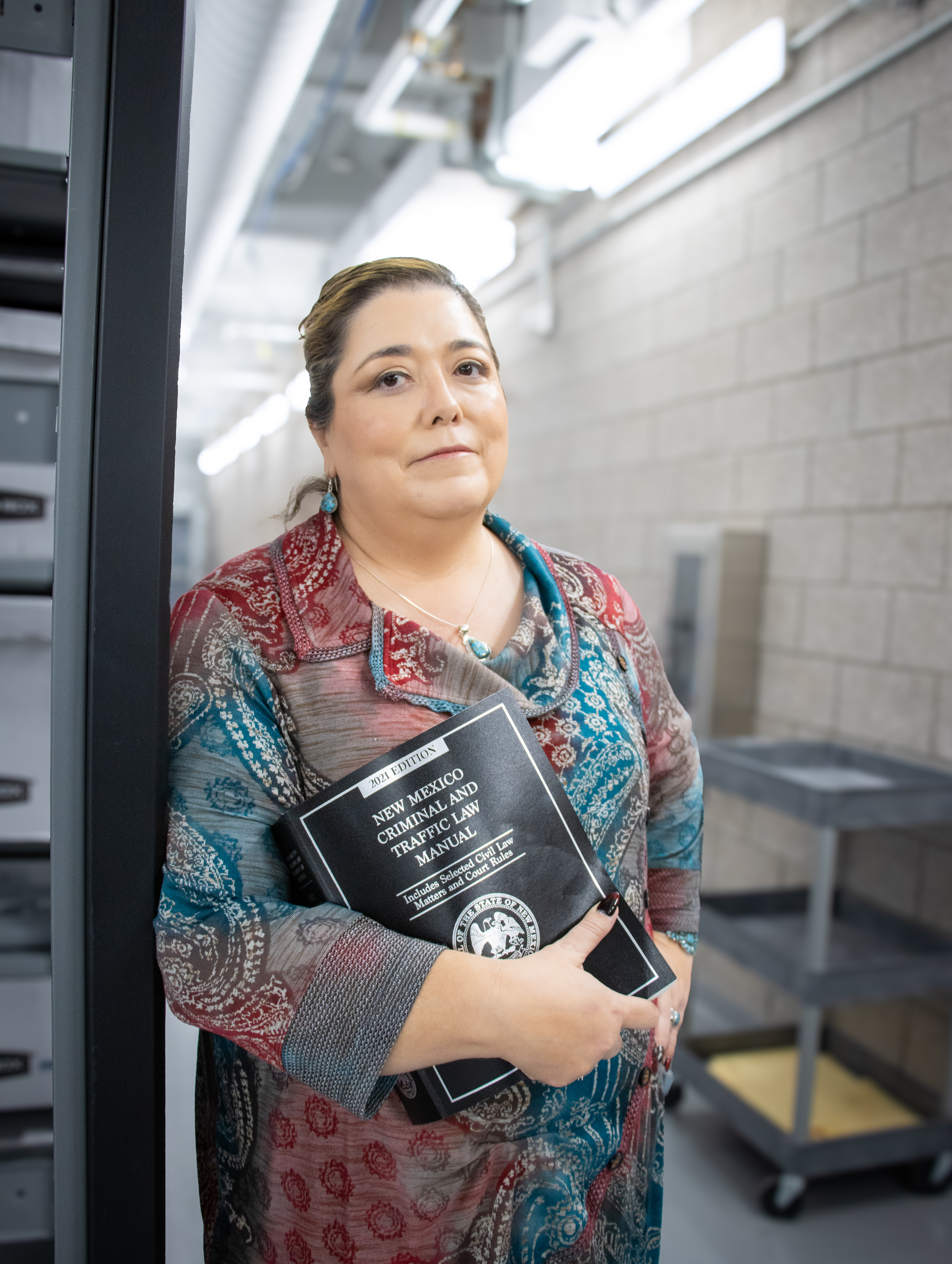 Jessica Mascareñas Rodarte at the headquarters of the New Mexico Department of Public Safety.
“This opens the door for people to truly move forward with their lives,” said Mascareñas Rodarte, who previously spent 12 years as a records and IT manager with the Santa Fe County Sheriff’s Office before joining the department over four and a half years ago. “Many individuals made mistakes when they were younger. As they grow, start families, and reflect on their past, they work to correct those mistakes and choose a different path. They want better futures for themselves, their children, and their grandchildren. Programs like this give them that opportunity and without it, we unnecessarily limit their ability to rebuild and move forward.”
“It feels good to expunge that for them and clean up their record and give back,” said McCutcheon who started her career as a probation and parole officer for five years and then worked as a program manager for the drug court for the 13th judicial district in Sandoval County. “I love that part of this job to give them a second chance. Having previously worked in the courts and seen the impacts to lives and then being able to come over here and give them an opportunity to better themselves is satisfying.”
Similarly, for Kathy George, a management analyst for the Expungement Unit who used to update criminal records with the criminal computerized history team, now gets the opportunity to remove some of those arrests from the record.
“I enjoy doing the work – it feels good,” said George, who has been doing expungements since 2020 and has almost 21 years with the department.
 From left to right: Kathy George, Jessica Mascareñas Rodarte and Karen McCutcheon at the headquarters of the New Mexico Department of Public Safety.
For Mascareñas Rodarte, George and McCutcheon the work fits their personalities as they like to be organized; and cleaning up files and records gives them a strong sense of satisfaction.
“We like being structured with attention to detail,” said McCutcheon. “I love going in there and being able to clean that up and put in a disposition – whatever the court decides so it is a complete record for both law enforcement and anyone else who is looking at their history.”
Recently, multiple systems used and managed by the Law Enforcement Records Bureau are under modernization and upgrades for record-keeping, which in turn will ultimately improve not only the processes for the employees in the Expungement Unit but agencies throughout the State of New Mexico.
“It is a huge undertaking,” said Mascareñas Rodarte, who said creating standard operation procedures is a critical part of the plan to ensure continuity. “We started thinking, what happens when Kathy retires, what happens when I leave or Karen leaves, and someone comes and takes our place. We need this crucial work to continue. It is critical for public safety throughout New Mexico and for support of all the civil and criminal justice agencies around the state, that we have people come in, learn what Kathy and Karen have been doing, and can pick up where they left off.”
 Karen McCutcheon at the headquarters of the New Mexico Department of Public Safety in Santa Fe, New Mexico.
 Kathy George at the headquarters of the New Mexico Department of Public Safety in Santa Fe, New Mexico.
Expungements are available in case of identity theft, arrest and charges (without conviction), and convictions. Waiting periods vary. For identity theft, there is no waiting period. For arrest and charges (without conviction), the waiting period is one year from the final disposition. For convictions, the waiting period depends on the degree of the offense and after the final disposition (i.e., a first-degree felony is 10 years, a misdemeanor is 2 years).
For those that are eligible, the first step is to access the authorization form for a state background check and obtain a set of fingerprints to send to the FBI for a federal background check. Convictions need both the Department of Public Safety New Mexico Records of Arrests and Prosecutions sheet and FBI RAP sheet, but arrest and charges (without conviction) require only the New Mexico Department of Public Safety RAP sheet. The expungement petition due to identity theft does not require either RAP sheets.
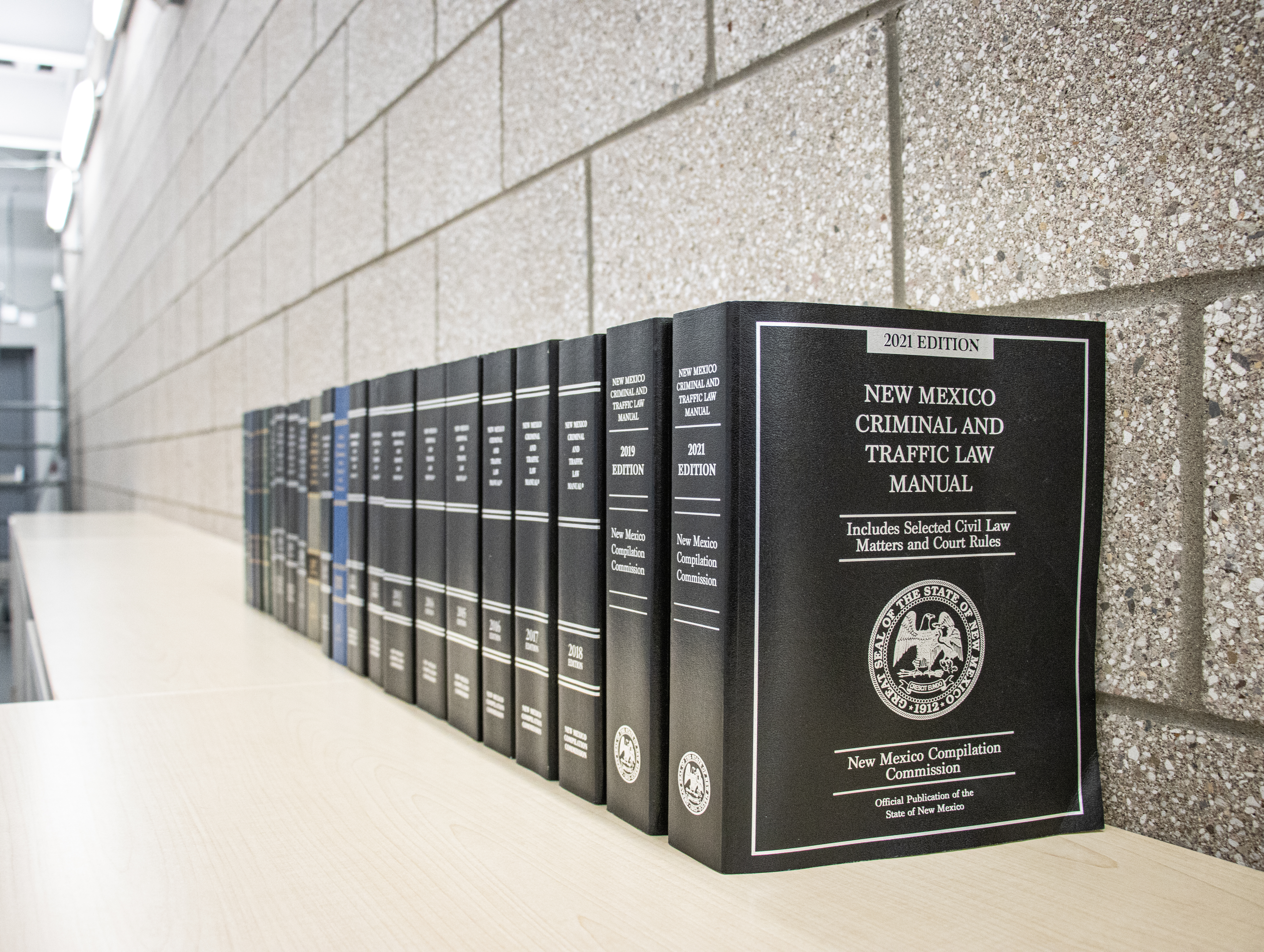 New Mexico Criminal and Traffic Law and other books used by the Expungement Unit.
Once the background checks are received the petitioner includes them in their petition to the district court in which they were arrested. The RAP sheets are part of the expungement application and included in the filed petition but also must be sent to all parties.
The district court then decides whether to grant the expungement, after which the Expungement Unit will follow the decision of the court. The expungement will be processed at the state level, and a notification will be sent to the FBI to be sealed on the department’s behalf.
Orders from the court granting the expungement don’t always specifically state what arrest or what charges are to be sealed, according to George. Rather they receive a court case number which says that anything that corresponds to that case number is what should be sealed.
“This means we have to go into our New Mexico CJIS (Criminal Justice Information System) database to find all of the arrests that pertain to that case number and that would include warrants, probation and parole and incarceration for that case,” said George.
 Kathy George looks at expungement files at the headquarters of the New Mexico Department of Public Safety.
“It takes some research through the case history and can be quite tedious,” said McCutcheon. “If it is all in one county, we may have to expunge 20 arrests – it can get big and complicated.”
George said it’s important for the dispositions (decision in a legal matter) to be included in expungement process in order to show if a case is dismissed for example.
“In that situation it would help in the determination whether they get a firearm or not,” said George of a dismissal of charges.
For juveniles (up to age 17), expungement involves a full deletion from the New Mexico-Criminal Justice Information System at the department and federally with the FBI.
“As a juvenile, it’s like it never happened,” said George.
Other requests the Expungement Unit receives include calls from the public about their records not being correct.
“I think it is particularly rewarding when Kathy and I are able to fix those issues,” said McCutcheon. “When you get to help the public and fix somebody’s record that is satisfying – making it accurate. We get random issues such as when a law enforcement agency is testing out their Livescan machine that takes fingerprints for arrests, and they put in a murder charge erroneously into the system on a staff member (a training mishap) and Kathy works with the FBI to fix it.
“I think it’s important for the public to know that there is a program out there where you can get your record expunged.”
For more:
Types of Expungements and Requirements:
- Identity Theft
- Petitioner must provide proof of the identity theft.
- Arrest or Charges (without conviction)
- Dismissal of cases involving violations of the criminal code or violations or deferments of violations of the New Mexico Motor Vehicle Code (excluding DWI).
- Department of Public Safety RAP sheet
- Petitioner must not have any pending criminal cases and must not be incarcerated.
- There is a waiting period of one year from final disposition which includes the completion of the sentence, including supervised or unsupervised probation, payment of fines, fees, and restitution.
- Convictions
- Petitioner must provide a description of the reason for the expungement and explain why justice will be served by granting expungement.
- This type of expungement includes violations of the New Mexico Criminal Code (both felony and misdemeanors).
- The following offenses are ineligible for expungement: DWI, offense committed against a child, offense that caused great bodily harm or death of another person; sex offenses, and embezzlement offenses.
- Department of Public Safety RAP sheet
- FBI RAP sheet dated no more than 90 days prior to the filing of the Petition.
- The required waiting period depends on the degree of the offense and starting from the time of the final disposition which includes the completion of sentence, including any probation, payment of fines, fees, and restitution.
- Petitioner must not have pending criminal cases or be incarcerated at the time of the filing of the petition (see required waiting periods).
How to Apply:
- Forms: Expungements – NM Department of Public Safety
- Petitioner has the burden of proof for proving all the statutory requirements.
- To get Department of Public Safety RAP Sheet go to https://www.dps.nm.gov/wp-content/uploads/2022/06/Authorization-for-Release-of-Info_2021.pdf.
- To get FBI Identity History Summary Check (RAP Sheet) go to: https://www.fbi.gov/how-we-can-help-you/more-fbi-services-and-information/identity-history-summary-checks
Story by New Mexico Department of Public Safety Public Information Officer John Heil. Photos by DPS Media Relations Unit – Curtis Althaus.