
The Department of Public Safety’s New Mexico Law Enforcement Academy recently hosted a ‘game-changing’ class for 12 law enforcement professionals.
The class – a 5-day P.E.A.C.E (Preparation and Planning; Engage and Explain; Account, Clarification, Challenge; Closure; and Evaluation), Investigator Interview Course managed by Forensic Interview Solutions took place May 4-8, 2026 at the academy in Santa Fe.
The P.E.A.C.E. model, originally developed in the United Kingdom during the 1980s, emphasizes information gathering rather than confession-seeking. Instructor Gary Patzer, a former Colorado law enforcement officer with 33 years of experience, said many older law enforcement interviewing methods focused heavily on obtaining confessions from suspects, sometimes at the expense of gathering accurate and complete information.
“Our goal is gathering information to find out what actually occurred,” Patzer said. “What’s the truth? We allow people to tell their story first. And then we break it down.”
He explained that the training separates interviews into two major frameworks. The first is the cognitive interview, designed for cooperative victims and witnesses. That approach uses scientifically supported memory retrieval techniques and “memory-compatible” questions intended to help people recall events more accurately and in greater detail.
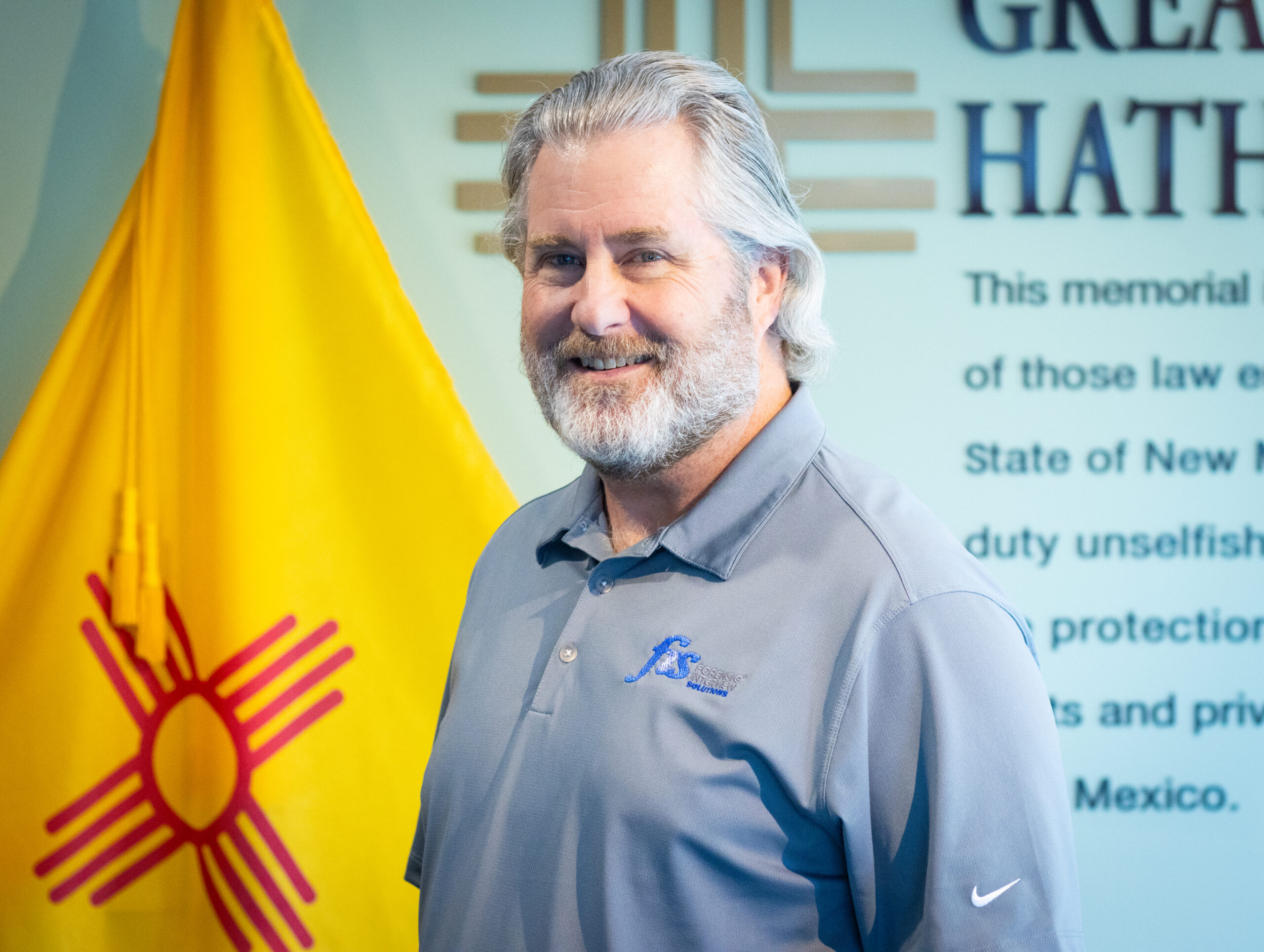 Gary Patzer with Forensic Interview Solutions.
The second framework, called conversation management, is used for reluctant or uncooperative interviewees. That could include suspects, but also hesitant witnesses or victims. Rather than relying on intimidation or psychological pressure, instructors teach investigators how to use evidence strategically and ask structured questions to uncover inconsistencies.
Patzer stressed that many common assumptions about detecting deception are not supported by science.
“You can’t tell if somebody’s lying by which direction they’re looking, or fidgeting,” he said. “Scientifically, that’s been debunked for years.”
The course also addresses false confessions, a growing concern in criminal justice systems nationwide. Patzer referenced research comparing P.E.A.C.E.-style interviewing to more aggressive interrogation techniques. While some confession-based models produced higher confession rates overall, many of those confessions were later determined to be false. According to Patzer, P.E.A.C.E.-generated confessions occurred without the same level of false admissions because the method avoids coercive tactics.
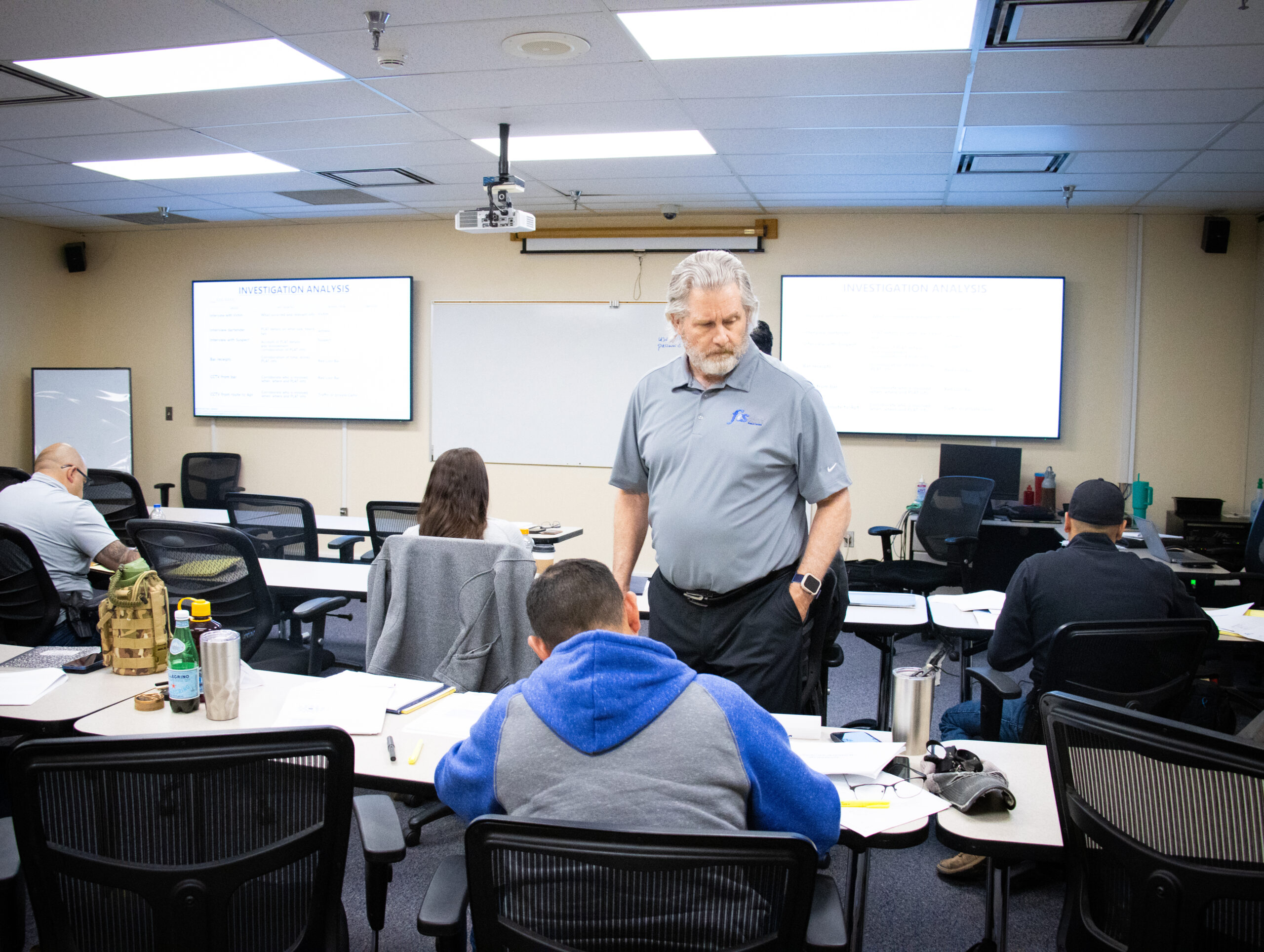 Gary Patzer with Forensic Interview Solutions teaching the P.E.A.C.E 5-day investigator interview course at the New Mexico Law Enforcement Academy.
The P.E.A.C.E. framework was developed collaboratively by law enforcement officials, legal professionals, judges, attorneys, and psychologists in the UK. Their goal was to create a non-coercive interviewing methodology that would stand up in court while still producing reliable information and legitimate confessions when appropriate.
Patzer said the course also aims to improve trust between law enforcement and the communities they serve. A major component of the training focuses on avoiding confirmation bias and tunnel vision – situations where investigators become fixated on one theory or suspect and ignore contradictory evidence.
“We teach the exact opposite of that,” Patzer said. “And our techniques do not rely on psychological pressure, intimidation, or coercion.”
One principle taught throughout the course is summarized with the acronym “ABC”: Assume nothing, believe nothing, check everything.
The training also includes extensive practical exercises. Participants are divided into groups where they rotate through roles as interviewer, interview subject, and evaluator. Patzer said this hands-on approach is what separates the program from lecture-based instruction.
“People don’t fully understand the method until they put it into practice, applying the techniques in realistic scenarios which we do in the class,” he said.
Students practice conducting interviews in realistic but fictional scenarios so they can apply the concepts immediately. Patzer emphasized that every participant is actively involved at all times, either conducting interviews, role-playing, or evaluating others’ techniques.
The structure of the P.E.A.C.E. method itself is another major focus of the course. Patzer said investigators are taught to explain the interview process clearly to participants and establish rapport before asking substantive questions.
Rapport-building can be especially important for patrol officers interacting with people in the field. Even small adjustments – such as moving someone away from a chaotic scene or briefly explaining how the conversation will proceed – can improve communication and increase the amount of information gathered.
The techniques are designed to work across a broad range of settings, not just criminal investigations. Patzer said Forensic Interview Solutions trains professionals in both the public and private sectors, including human resources investigators, threat assessment teams, auditors, and federal agencies such as the FAA. The organization has also worked internationally and is exploring training opportunities with major corporations.
Patzer noted that adapting to the P.E.A.C.E. model can be difficult for some veteran investigators who were trained under confession-focused systems.
“I had a boss at one time tell me, ‘Go in that room and don’t come out until you get a confession,’” he recalled.
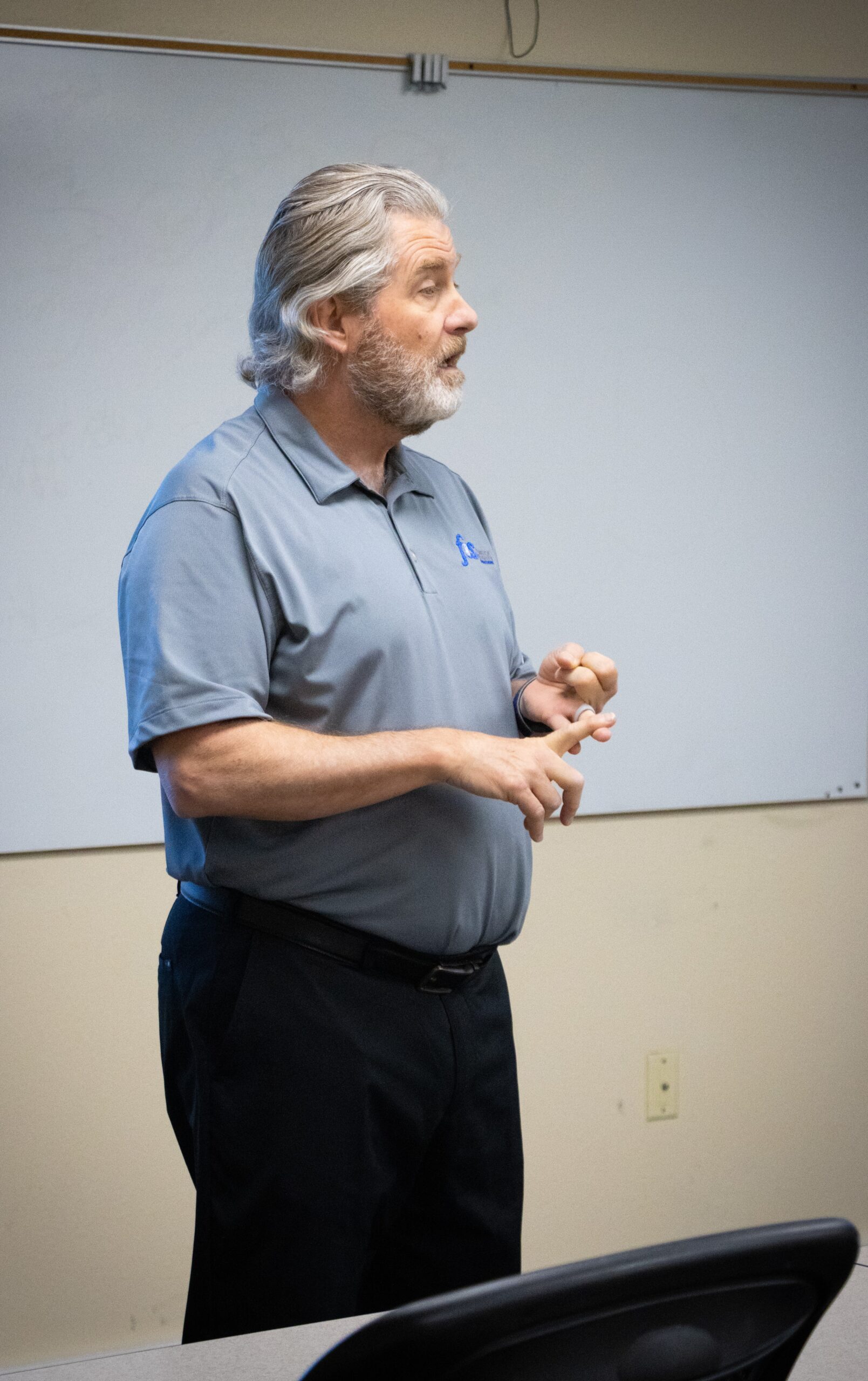 Gary Patzer with Forensic Interview Solutions.
However, he said many newer and mid-career officers are more receptive to science-based interviewing approaches because they provide structure while reducing the risk of coercion and wrongful accusations.
The course also encourages investigators to consider cultural, language, and gender dynamics during the planning phase of interviews. Patzer said interviewers should think carefully about whether interpreters are needed, whether cultural norms may affect communication, or whether another interviewer might be more appropriate in certain situations.
Although smaller agencies may have fewer resources to accommodate those considerations, Patzer said awareness alone can help investigators create more effective interview environments.
Patzer shared one example from his own investigative career where the approach proved particularly effective. During a lengthy witness interview conducted in a comfortable (on a couch), non-threatening setting, the witness eventually remarked that the conversation “felt more like a therapy session than an interview.” According to Patzer, the witness was surprised by how much information they were able to remember once they felt relaxed and supported rather than pressured.
He believes that environment, structure, and rapport are central to obtaining reliable information.
By the end of the course, Patzer said the goal is simple: officers should leave as better interviewers than when they arrived.
“The only goal in our methodology is the truth,” he said. “A lot of people observe what they see on TV, and that’s what they assume is going to occur in any interview with law enforcement. We don’t want that to be the case.”
Story by New Mexico Department of Public Safety Public Information Officer John Heil. Photos by DPS Media Relations Unit – Curtis Althaus.